
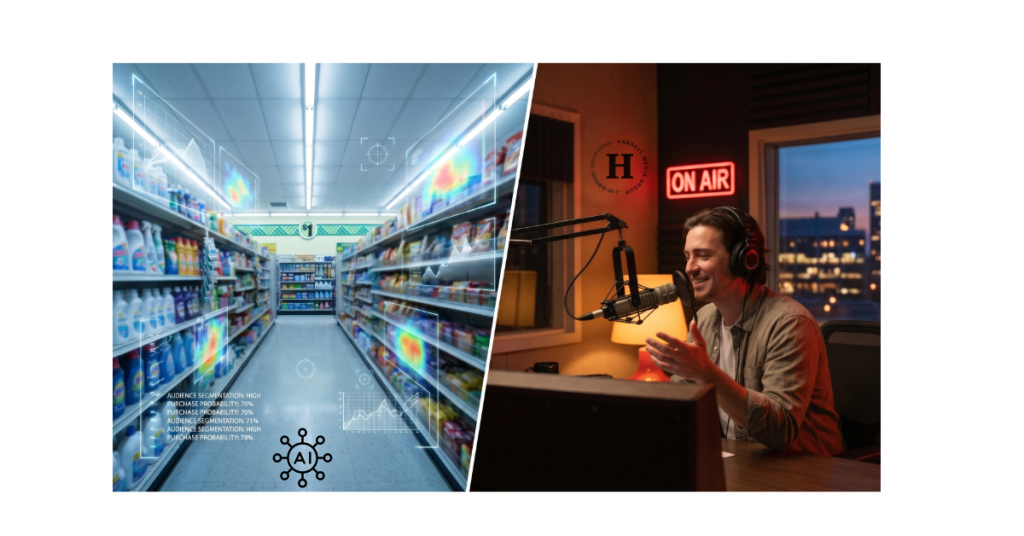
When a chain store can run different audio content in stores three miles apart, what does it mean for the medium that’s always been “everywhere”?
It was only a few years ago that I saw the initials AI, and my brain immediately echoed, “Al,” like a short form of the name Albert. “That will be a constant mental trip when referencing artificial intelligence with the letters AI and the ‘I’ without a crossbar at the top and bottom of the letter,” I silently theorized.
I was wrong. How quickly those two letters became the fastest brand identification in the Information Technology Age, impacting everything from education tactics to audio distribution. Now, when I see the first name “Al,” like Al Gore, my mind interprets it as artificial intelligence before I correct it to Prince Albert’s nickname.
Dollar General recently introduced an AI-enabled audio system in nearly 6,000 DG stores with plans to have it in 12,000 of the chain’s stores by the end of Q2.
“This platform allows us to deliver localized, real-time messaging at scale across the thousands of communities we serve – especially in underserved and often overlooked rural areas,” said Austin Leonard, vice president and general manager of DG Media Network.
Is This Radio?
Sounds like radio, right? Yeah, except Dollar General’s AI-audio system is hyperlocal in a way radio structurally isn’t.
Their system will allow it to:
- Change the music in each store
- Focus the in-store ads based on the neighborhood demographics
- Run different content in stores three miles apart
It’s algorithmic micro-targeting. Radio can’t do that, at least not on the analog signal. The stream is a different conversation involving geo-targeted messaging and dynamic ad insertion. And here’s the point: Radio shouldn’t try to. It’s not a weakness, it’s the defining strength of the medium’s future.
Radio is a one-to-many medium. “Broadcasting” always has been a shared experience. Just ask sports radio content creators. But do we position it that way?
Talent coaches teach on-air hosts to talk to one person so the driver in the car feels like you’re talking to them, not to the thousands of others experiencing the same moment. Makes sense, and it creates a subconscious personal connection between the listener and the host.
“We’re EVERYWHERE!”
For decades, radio stations would flex their reach muscles by naming suburbs and towns within the signal pattern. The tactic implied the station was “everywhere.” That word got used a lot in public service audio imaging: “WBBB is EVERYWHERE.” However, the strategy was intended to show our competitive reach, not necessarily to bring the community together with a shared experience.
The digital age made the signal size less important because the station’s stream could be heard anywhere. Plus, the increase in LPFMs (Low Power FMs) meant more signals with less coverage in a market. So, your 1kw Class A signal that covered a third of the market didn’t promote its size compared to the 100kw station with a signal that stretched outside the DMA.
The shared experience becomes a difference for broadcasters. Great. But what do we do with that difference? It means very little if we’re not creating a branding and sales strategy based on this unique characteristic. Also, “shared experience” isn’t transactional. There’s nothing to immediately quantify like “Commercial Free,” “News on the Hour,” “The Two Minutes Promise,” or “Always 10 Songs in a Row.”
It’s a feel.
The benefits of a shared experience are found in community and connection. A hyperlocal AI playlist in aisle four won’t bring people together, but radio does. Why? Because the shared experience creates a virtual cultural watercooler.
It’s the reason morning shows still drive massive loyalty. Listeners subconsciously know that thousands of their neighbors are laughing at the same joke or debating the same topic at the exact same time. Collective participation builds a level of trust that algorithmic targeting simply cannot manufacture. Oh, and aside from deep focus groups, this isn’t a researchable characteristic. It’s a feel. This is the power of understanding the art of human connection through a shared experience.
For brand managers and sales teams, this is the pitch: We don’t just deliver to an audience. We deliver a community. Advertisers aren’t just buying reach. They’re buying into a trusted, shared environment.
Sell Our Cultural Footprint
If we want to compete in a world of AI micro-targeting, we have to stop selling our signal & digital reach and start selling our cultural footprint. Make the shared experience your primary branding strategy, and watch local businesses want to be part of that conversation.
You’re asking, “But what difference are we sharing when radio continually sounds more like generic digital streams found in a chain store?” That’s another column and conference, but the quick answer is, “Quit sounding like generic digital streams found in a chain store.”
Any brand trying to sell its difference externally must first understand its unique narrative internally. The evolutionary process is nurtured through discussion, debate and disagreement to create storyline alignment.
That’s easy for me to type (not really, because I rewrote that paragraph three times). But if radio is to extend its life beyond analog towers and into digital distribution exclusively, it has to think beyond differences in content.
Final Questions
Here are questions to ask ourselves:
- Do those content differences come together to create a shared experience for the audience and consumers?
- Do we communicate the shared-experience difference in our branding and sales conversations?
One more question: Will consumers desire radio’s shared experience on the next big distribution platform once the towers come down?

 English