
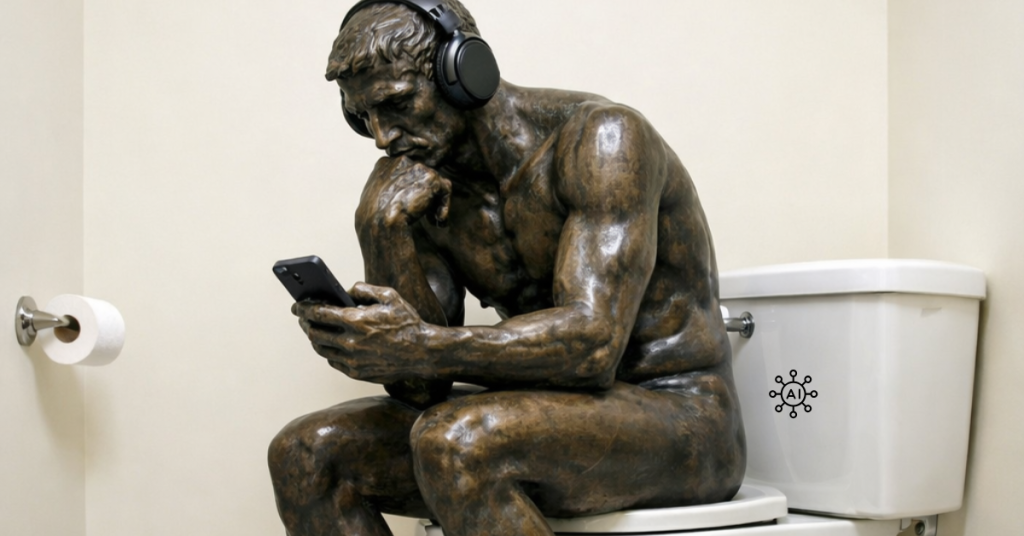
Do we really need this convenience? Chinese automaker Seres has a patent for a voice-controlled in-car toilet. My first reaction was the olfactory sensations of that experience. But my StoryFinder curiosity quickly revealed the potential for content creators and the radio medium: more Time Spent Listening and Viewing.
For most of my adult life, Modern Plumbing has been the answer to the dinner party question, “What is the most important invention of the last 150 years?” In 2026, my answer hasn’t been updated to Artificial Intelligence. It’s still Modern Plumbing.
Before you question my use of “Modern” in the long history of plumbing, yes, I’m aware plumbing made advances during the Roman Empire and as far back as 3000 BC in what is now Pakistan.
History can be ‘draining’ (this post is pun-101)
However, mankind doesn’t always advance, and the Middle Ages are a perfect example of Western civilization’s contentment with chamber pots and outhouses.
Maybe the brains behind the U.S. Constitution inspired aqua engineers to make their mark on the world. Philadelphia became the first city to adopt a full cast-iron pipe system in 1804. The ideas flowed west and Chicago installed the first U.S. sewer system in the mid-1850s.
Having been humiliated in the Revolutionary War, the British would not let it happen again. Chief Engineer Joseph Bazalgette designed and completed a transformative integrated sewer system for London in the 1870s. It’s still in use today.
When you research this technological phenomenon, you’ll learn it had nothing to do with the embarrassment of the American Colonies abandoning the throne. There was a need in London that outweighed human convenience, and when you read about The Great Stink of 1858, you’ll have a deeper appreciation for the porcelain and you’ll never want to abandon the throne.
Occasions create the ratings
So what does this have to do with Time Spent Listening (TSL) or Average Weekly Time Exposed (AWTE) in the content-creation and radio-ratings world? I’m glad you’re feeling the urge.
If the Chinese engineers predict humans will spend more time in automobiles, then there’s more exposure to the automobile dashboard or more time looking at a device as the automobile drives you around. If modern ratings are about occasions, then the listener or the viewer in the Seres automobile can give your brand a little more time as they relieve themselves in the front seat.
It’s that simple. However, because the porcelain, or in the case of the Seres car…plastic, throne is considered a thoughtful moment, let’s ask ourselves, “What are we doing to encourage more listening occasions or longer times spent listening?”
Electronic mediums like television, radio and podcasting have long used teasing and benchmark content tactics to extend and create habitual engagement.
The tactics
- Top/Bottom of the Hour News on the radio and television.
- Contesting at benchmark times (Win $1,000 at 7:20 when we play The Thousand Dollar Minute!)
- Promoting new music: “Taylor Swift dropped a song at Midnight, and you’ll hear it next.”
- Patterned TV newscasts: News, weather, sports, all in 30 minutes.
- TV News magazines “Dateline” and “20/20” have perfected the art of turning 20 minutes of content into a one-hour show by dragging out the storyline and teasing “coming up next…”
- ESPN’s “Pardon The Interruption” displays a list of the upcoming topics on the right side of the screen. I may not be interested in the NBA or PGA stories, but I’m curious about their thoughts on the crazy ending to Game 3 of the Stanley Cup Finals. I see it’s coming up and I’ll sit through the NBA and PGA stories.
- Effective podcasting uses narrative cliffhangers to create binge-worthy episodes in true crime or serialized storytelling.
The list of teaseable tactics could take up another blog post, and if the person using the toilet in the Seres is the type who likes to read on their smartphone while doing their business, well, it could be a long blog.
Goldfish are still reading this
In an era when human attention spans are about as long as a Goldfish’s, I believe we’ll get back to the level of a more focused dolphin. However, we should work with the lowest common denominator to ensure full acceptance. Sidebar: When you research the human and Goldfish attention span theories, you’ll find out it’s statistical mythology. Thank you, internet.
However, the competition for the human audience’s attention span is greater than ever. So, what are we promoting and teasing? Is it simply occasions of listening and viewing? And if that’s the case, then the next question becomes, “Do those occasions support and promote your brand’s differences?”
Promoting music by Taylor Swift, Bad Bunny, or podcasts by Joe Rogan, Mel Robbins, Crime Junkie, or news from NBC, Fox and PBS, will create an emotion based on the recognition of those brands. The challenge for the lesser-known content is to create teasers and benchmarks that speak with emotion and purpose.
Writers and talent understand how to deliver those storylines and content. But do they understand the mission and purpose to continue delivering the emotional narrative of your brand? Tactics often get confused with strategy.
Buc-ee’s bathrooms
Here’s the deep question: What are we doing to make that listener, viewer or reader want to stay with our brand when they decide to use their automobile porta-potty? Is the content experience better than stopping at Love’s or Buc-ee’s for a Modern Plumbing experience?

 English